Cataract Surgery or New Glasses?
As your parents grow older it can become increasingly difficult to decipher between a simple change in vision, something due to cataracts and something else entirely.
Sometimes it’s easy enough to tell when they’ve simply needed new glasses for some time.
More often than not, however, vision changes with age can be down to more serious ocular problems.
This can prove especially troublesome if you’re abroad, and your parents here in India don’t know exactly how to explain their problem, or if they’re misinformed.
How do you know when they need new glasses, and when it’s time for them to see an eye specialist?

First and foremost: Is the change actually indicative of something?
You can begin examining your parent’s situation by asking them a couple basic and very important questions. Such as:
“Chashma lagane ke baad clearly dikhta hai ya phir abhi bhi dhundhla lagta hai?”
If your parent is unable to read small print with his or her glasses on it is likely just a change in their near-sightedness prescription.
However, if they’re still unable to see clearly despite having the right reading glasses on it could be a sign of something more serious.
Cataracts certainly play a role, but changes in the cornea, retina, optic nerve and other parts of the eye can also play a part in vision changes in older adults.
This is why simply adjusting your parent’s glasses over and over again isn’t very useful if you aren’t able to find the root of the problem.
What are the signs and symptoms of cataracts?
Changes in vision due to cataracts almost always appear gradually.
Patients don’t wake up one day completely blind, but instead find themselves having to deal with slight changes in their vision over the course of several months or years.
Some of the most common symptoms of cataracts include:
- The TV doesn’t look as clear as before.
- I have to pay attention while driving at night.
- Headlights look very harsh.”Everything looks a bit blurry.“Colours don’t seem as bright as before.
- The glasses became cloudy, yet there was no significant difference.
While these are some of the most common symptoms of developing cataracts, it’s important not to jump to any conclusions regarding your parent’s diagnosis. Other eye diseases and ailments can cause very similar symptoms.
The fact that these sorts of changes in vision usually appear gradually is important, however, as it can provide insight into what the root cause of the problem could potentially be.

Vision changes at night are especially important to note
Most older patients who come to me complain about having trouble driving at night.
While many younger folks can have trouble adjusting to the glare of oncoming headlights, older folks find themselves having to deal with glare, halos around lights and generally worse night vision than before.
I suggest talking to your parent about their night vision and seeing whether or not they have trouble with it. It doesn’t necessarily mean that they have cataracts, but it is definitely one symptom that should raise a few red flags.
What if my parent is having trouble reading?
Unfortunately this can be one of the most confusing ailments to deal with, as it usually has to do with an eye condition called presbyopia. Presbyopia is more common in older individuals, and it is characterised by a gradual loss of the eye’s ability to focus on near objects.
A lot of older folks have trouble focusing on things that are close to them such as phones or books. This usually causes them to hold these objects further away or to read under brighter lighting conditions. These issues can usually be dealt with simply by using reading glasses. However, if your parent is not only having trouble reading but also with recognising faces at a distance, watching TV, going outside and seeing other objects clearly it could potentially be something else. An eye examination could help determine whether or not this is a problem stemming from presbyopia or from something else.
Does that mean my parent needs cataract surgery immediately?
Not necessarily.
The only way to understand if your parent needs cataract surgery is to understand if their cataracts are interfering with their daily lives in any way.
If your parent has a small cataract that isn’t really affecting their vision in any noticeable way their ophthalmologist may decide to simply monitor it for now. On the other hand if their cataract has grown large enough to affect their ability to do everyday tasks such as driving, reading, watching TV etc. with ease it may be time for surgery.
Ultimately it’s up to the ophthalmologist to determine whether or not your parent needs cataract surgery based on his or her individual circumstances, symptoms and eye condition.
What about LASIK?
LASIK eye surgery and cataract surgery are pretty different procedures.
LASIK is used to correct refractive errors that affect the eye’s focus and is generally used to reduce a person’s dependency on glasses or contact lenses.
Cataract surgery, on the other hand, deals specifically with removing the eye’s clouded natural lens and replacing it with an artificial one.
LASIK surgery isn’t really something that older patients should consider if they have significant cataracts, as simply reducing their dependence on glasses isn’t really going to address the issue of the clouded and damaged natural lens.
Whether or not someone with cataracts is eligible for LASIK eye surgery will depend on several different factors so it’s best to talk to an eye specialist and schedule a consultation.
When you're overseas, ask your parents these five questions
Asking your parents these five simple questions can help you determine if an in-depth eye examination is necessary to figure out what’s going on.
1. “Do you still see blurry after wearing glasses?”
2. “Do you glare more from headlights at night?”
3. “Do colors seem duller than before?”
4. “Do you have more trouble reading or using your mobile phone?”
5. “Do you see clearly after wearing glasses, or is it still blurry?”
If your parents answer “yes” to most of these questions, it’s probably a good idea to get them to schedule an eye examination. Keep in mind that these questions can’t definitively tell you whether or not your parents have cataracts. They’re simply meant to help you determine whether or not their case warrants an in-depth eye examination.
Remember to ask about glaucoma and diabetes as well
Cataracts are definitely one of the most common eye diseases to develop with age, but they aren’t the only ones.
In fact, there are several other eye diseases and conditions that can develop as a person gets older. One of these particularly dangerous ailments is glaucoma, which generally doesn’t show any symptoms until it’s too late.
Glaucoma can cause gradual vision loss that many people mistake for age-related vision changes. High eye pressure is another tell-tale sign of this condition, but a lot of people tend to ignore it as most people don’t really know much about it.
Diabetes can also cause vision changes, most of which are related to diabetic retinopathy.
This is why an eye examination should definitely go beyond a simple examination of the eyes’ refractive power. An experienced eye specialist will take into account your parents’ age, vision, symptoms and pre-existing conditions before performing an eye examination. Depending on the doctor’s suspicions he or she may also perform a few additional tests pertaining to your parent’s unique situation.
What happens when you visit an eye specialist?
The first thing that your eye specialist will do is ask you about the changes you’ve noticed in your vision and about any symptoms you may be experiencing.
He or she will also ask you whether these changes have been happening for a while and whether these changes are happening in one or both of your eyes.
The doctor may also ask you about your ability to read, see things at a distance, see things at night, and whether your recent glasses prescription has changed.
He or she may also ask you about your parents’ general health, pre-existing conditions and whether your parents have any history of eye diseases.
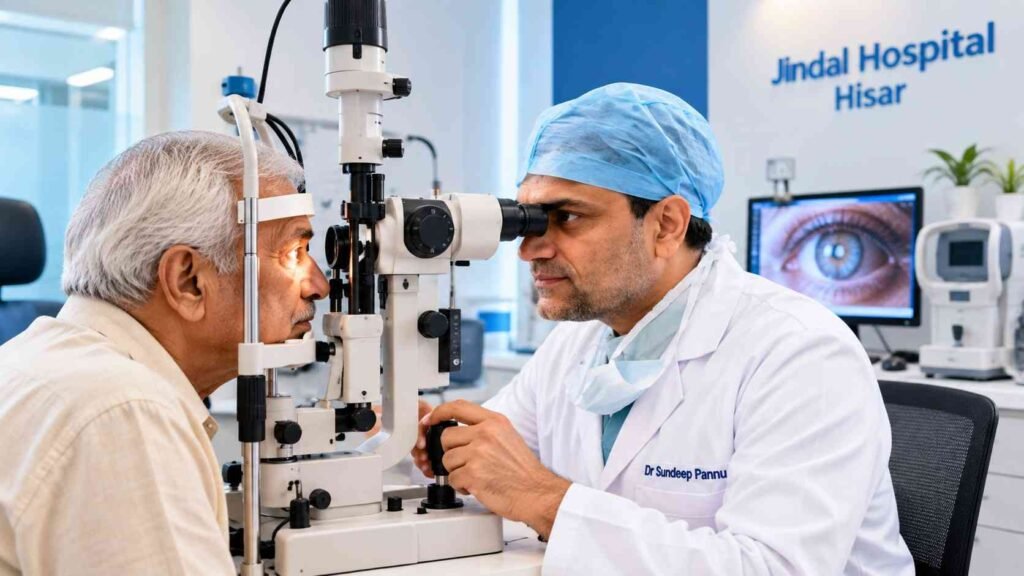
After discussing all of these things the doctor will perform a thorough eye examination and will conduct a series of tests to determine the root cause of your vision changes. If your parent has cataracts the severity of the condition will also be determined so that he or she can decide if and when cataract surgery is necessary. The same will be done for any other potential eye conditions.
This is much better than trying to assume that simple changes in vision are due to changing prescriptions when they could actually be caused by something else.
Small changes can be easy to overlook
One thing that I tell a lot of people is not to wait before having their eyes examined.
A lot of people only bring up the idea of an eye examination when they wake up one day and find themselves unable to see properly.
However, a lot of eye conditions tend to develop gradually.
They can start off very subtly, and the only way that people tend to notice them is when the condition progresses to the point where they can’t do things that they used to be able to do.
They stop driving at night as they find themselves unable to see the road ahead.
They change the settings on their phone or TV because they can no longer see them without having trouble.
They sit closer to the TV and ask others to read things out loud to them.
They start thinking to themselves, “This must be due to old age”.
All of these small changes that people experience as they get older can be early warning signs of developing eye conditions.
When should you schedule an eye examination instead?
Gradual changes in your vision can usually be diagnosed during a regular examination.
However, sudden changes in your vision should always be taken seriously.
Sudden vision changes can range from loss of vision to worsening of your eyesight overnight.
Sudden flashes of light and sudden changes in the amount of floaters that you see can also be a sign that something isn’t right.
These changes can also occur alongside other symptoms such as loss of peripheral vision, severe eye pain, and other similar symptoms.
If you or your loved ones are experiencing any of these symptoms it’s important that you don’t wait before scheduling an eye examination.
For those of you who live abroad
If you happen to be an NRI and your parents are here in Hisar or nearby it’s important that you’re able to assist them as much as possible.
Ask your parents about any changes in their vision.
Store any previous eye reports or eye surgery reports if you have any.
If your parents have diabetes or other pre-existing conditions it’s important that they are able to get the proper eye care and treatment.
If they’re constantly complaining about their eyesight worsening it’s important not to jump to conclusions about them simply needing new glasses
Sometimes the more important question is asking why their vision has changed in the first place.
This can only be answered by visiting an eye specialist and getting their eyes examined.
Conclusion
As you can clearly see, new glasses can make a world of difference when it comes to simple changes in your prescription.
However if your parent finds themselves unable to see despite having glasses on it’s time to get their eyes examined.
This is especially true if your parent finds themselves having trouble with glare, night vision, colours appearing dull and being unable to engage in everyday activities without having trouble.
This could potentially be something as simple as cataracts or something more serious.
Whatever the case may be, figuring out the root cause of the issue is always the most important priority.
If you or your parents have noticed a change in your eyesight recently, an eye examination with Dr. Sundeep Pannu, Senior Eye Specialist & Ophthalmologist at Jindal Hospital, Hisar can help you figure out what the root cause of the problem is as well as what treatment, if any, is necessary.